Background
The 20MW organic Rankine cycle bi-turbine units were suffering from a higher than expected bearing failure rate. The alignment of the turbines to the generator is considered one of the primary possibilities why the bearings failure rate is higher than expected. The distortion of the turbine structure due to the exhaust pipe movement was suspected as contributor to the bearing failures due to the impact on alignment with the generator.
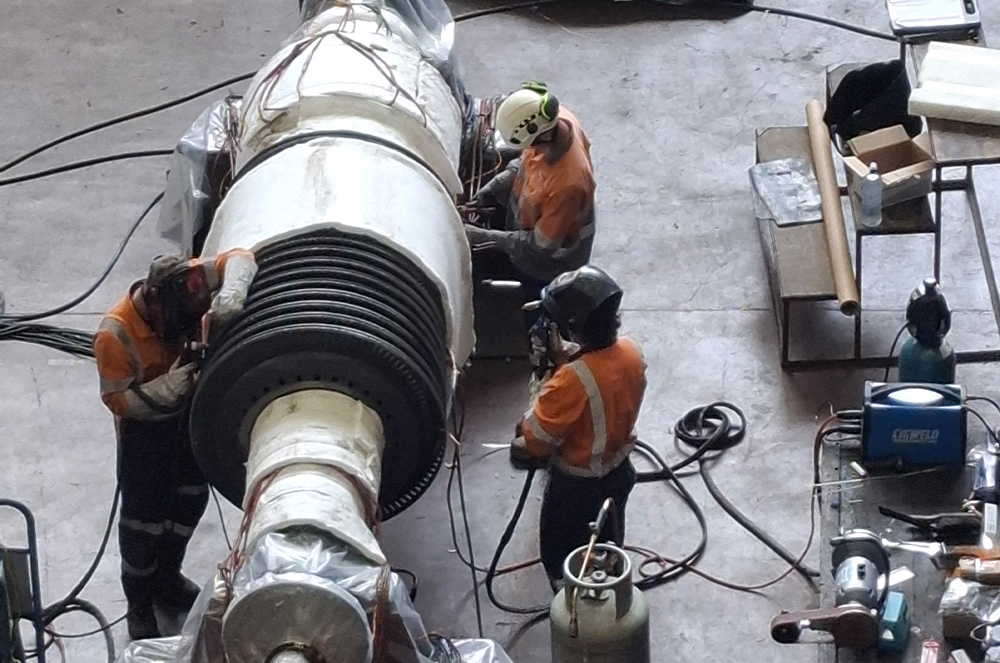
Photogrammetry measurement and study were done on one unit to evaluate the movement between the hot and cold conditions. The unit was measured in the hot condition and after shut down it was repeated in the cold condition. Laser alignment measurement results in the cold condition was used as baseline to determine the alignment changes during the transient from cold to hot conditions.
Findings
Four phenomena that have an impact on the structure were identified that had a significant negative impact on the turbine alignment.
Casing Expansion
The vertical movement of the drive and non-drive end of the turbine due to thermal expansion results in an angular-vertical movement of the centreline relative to the generator that is more than the specified alignment tolerance.
The analysis showed that the casing support below the centreline with the casing warmer on the drive end than the exhaust end, result in the drive end expanding more, causing the shaft and coupling to move upward and to an angle relative to the generator.
Support Structure Friction
Thermal expansion movement of the turbine casing on the support structure caused the structure to distort in the direction of the expansion movement. The distortion was found to be inconsistent and asymmetric. This is a negative scenario the support structure is subjected to undesired stress and it results in movement of the centreline and changes in the alignment.
The specified set-up of the palm supports was found to cause high levels of friction between the turbine casing and the pedestal palms causing the abnormal distortion.
Distortion Due to Exhaust Pipe Induced Force
Although the design of the exhaust pipe assembly incorporates features that should allow free movement of the pipework relative to the turbine structure, there is clear evidence of force being transmitted to the turbine structure resulting in movement of the turbine and distortion of the turbine exhaust. This movement had a direct influence on the alignment of the turbine to the generator.
The amount of and types of distortion measured is an indication of the severity and magnitude of the exerted forces.
Distortion Due to Internal Temperature Asymmetry
One turbine casing was found to bend going through the transient from cold to hot. The bending was caused by the asymmetric temperature distribution of the casing. The cause of this phenomena is due to the internal flow of pentane. The distortion affects the centreline movement and the alignment to the generator and can also result in turbine performance and reliability problems.
Conclusions
The phenomena all have a significant impact on the alignment and calculations shows that both of the turbines of the unit are running outside the alignment specification when in operation, indicating that the movement due to the transient from cold to hot have an impact on the reliability of the machine.
Recommendations were made on how to compensate for the movements found that will remove the risk and impact on the machine reliability.
Recommendations Made
- A review of a few specifications to remove the negative effects by changing the set-up of the machines in the cold condition.
- An off-set in the alignment to compensate for the known changes.
- An additional support to strengthen and stiffen the turbine support to withstand the induced movement.
- Photogrammetry is an ideal tool to confirm design intended behaviour of these machines as well as identifying abnormal phenomena.